Research page · Ecosystem maturity

Comparing ecological ecosystems and venture-backed innovation ecosystems.

This page presents a high-level conceptual framing from my research and practice: ecosystems can be understood as dynamic systems of interdependence, resource circulation, and co-evolution. That perspective helps explain why some innovation ecosystems mature—and why others reproduce the appearance of maturity without reproducing performance.

Ecosystems defined

A working definition across two domains.

Ecosystems are the continuous circulation of resources within and across boundaries relevant to supporting emergent synergies, balance, and resilience.

Ecology

Interdependence and dynamic equilibrium

In ecology, ecosystems are interdependent and co-evolving constructs, trending toward a dynamic equilibrium between diverse actors occupying complementary niches.

  • Diverse organisms play distinct yet connected roles.
  • Resources circulate across boundaries and trophic levels.
  • Resilience emerges through adaptation, redundancy, and relationship quality.
Venture-backed innovation

Co-evolving stakeholders in innovation

In venture capital and innovation, analogous ecosystem dynamics can be observed through co-evolving interrelationships among many diverse stakeholders—such as new technology pioneers, investors, service providers, accelerators, universities, corporations, government, and markets.

  • Founders do not scale alone; they depend on surrounding capabilities.
  • Knowledge, credibility, capital, and access move through networks.
  • Maturity depends on repeated interaction and learned coordination across the whole system.
Interpretive bridge

Why the analogy matters.

If innovation ecosystems are treated only as collections of isolated actors, we miss the co-evolutionary processes through which trust, capability, and performance are actually produced.

Resource flows

Both ecological and innovation ecosystems depend on the quality, direction, and continuity of flows—whether nutrients, information, expertise, or capital.

Complementary niches

System performance depends on distinct actors performing different roles well and connecting effectively with one another.

Resilience

Maturity is reflected not just in growth, but in a system’s ability to absorb shocks, adapt, and continue creating value.

Mature ecosystem view

When stakeholders co-evolve, the system becomes more complete.

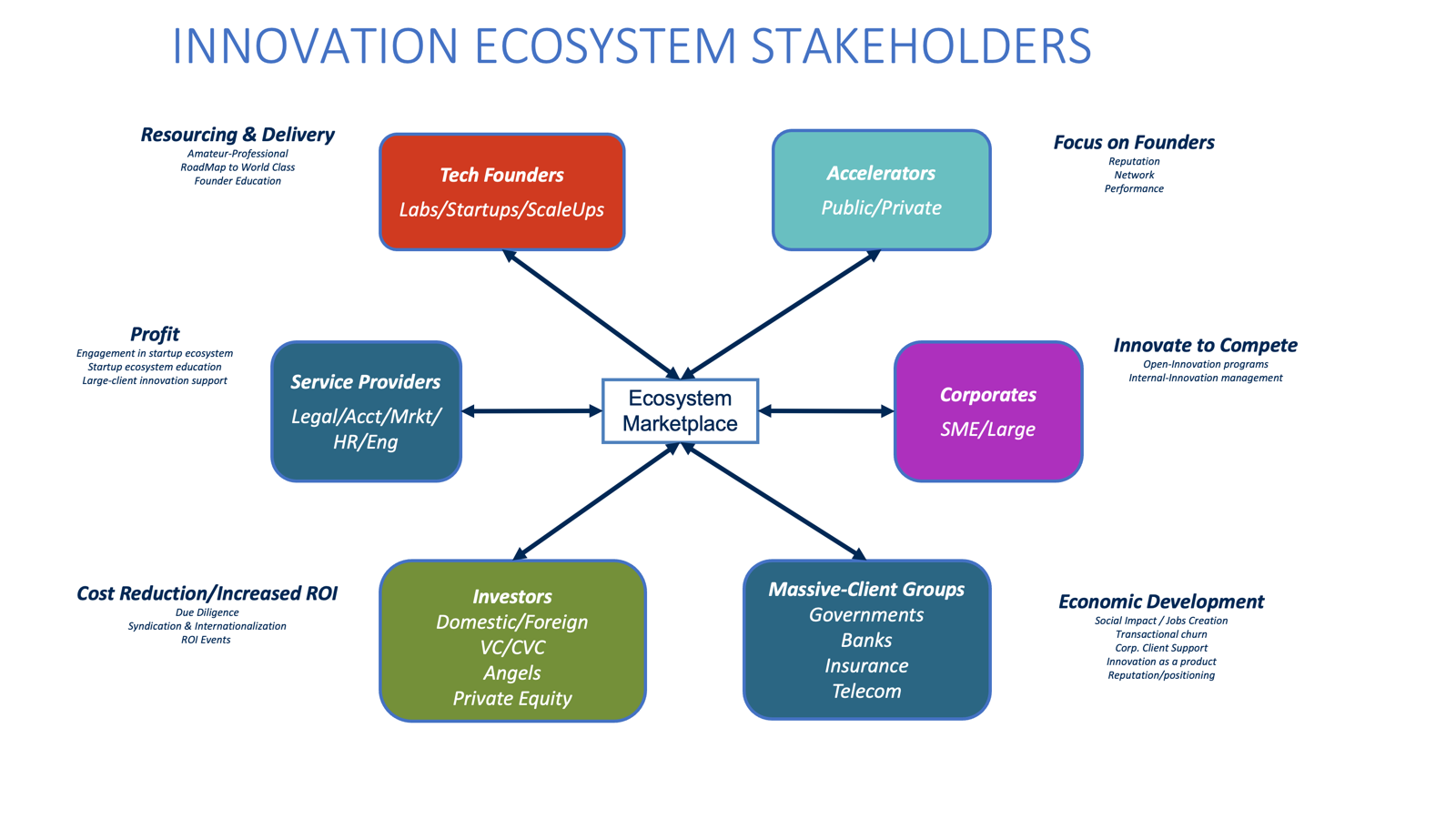
The graphic below presents a mature innovation ecosystem as a broad set of co-evolving stakeholders connected through an ecosystem marketplace. In mature systems, founders remain central—but they are not the sole focus. The surrounding support and delivery infrastructure is deeper, more specialized, and more interconnected.

Diagram of innovation ecosystem stakeholders in a mature ecosystem
A mature ecosystem includes founders, accelerators, corporations, service providers, investors, and large institutional client groups. These roles co-evolve rather than developing in isolation.
Emerging ecosystem challenge

Selective institutional mimicry creates structural gaps.

Emerging ecosystems often try to imitate the visible structures of more mature ecosystems, but without reproducing the historically contingent, relational, and co-evolutionary processes that made those structures productive. The result is selective institutional mimicry: attention and support concentrate on only a subset of stakeholders, while crucial roles remain underdeveloped.

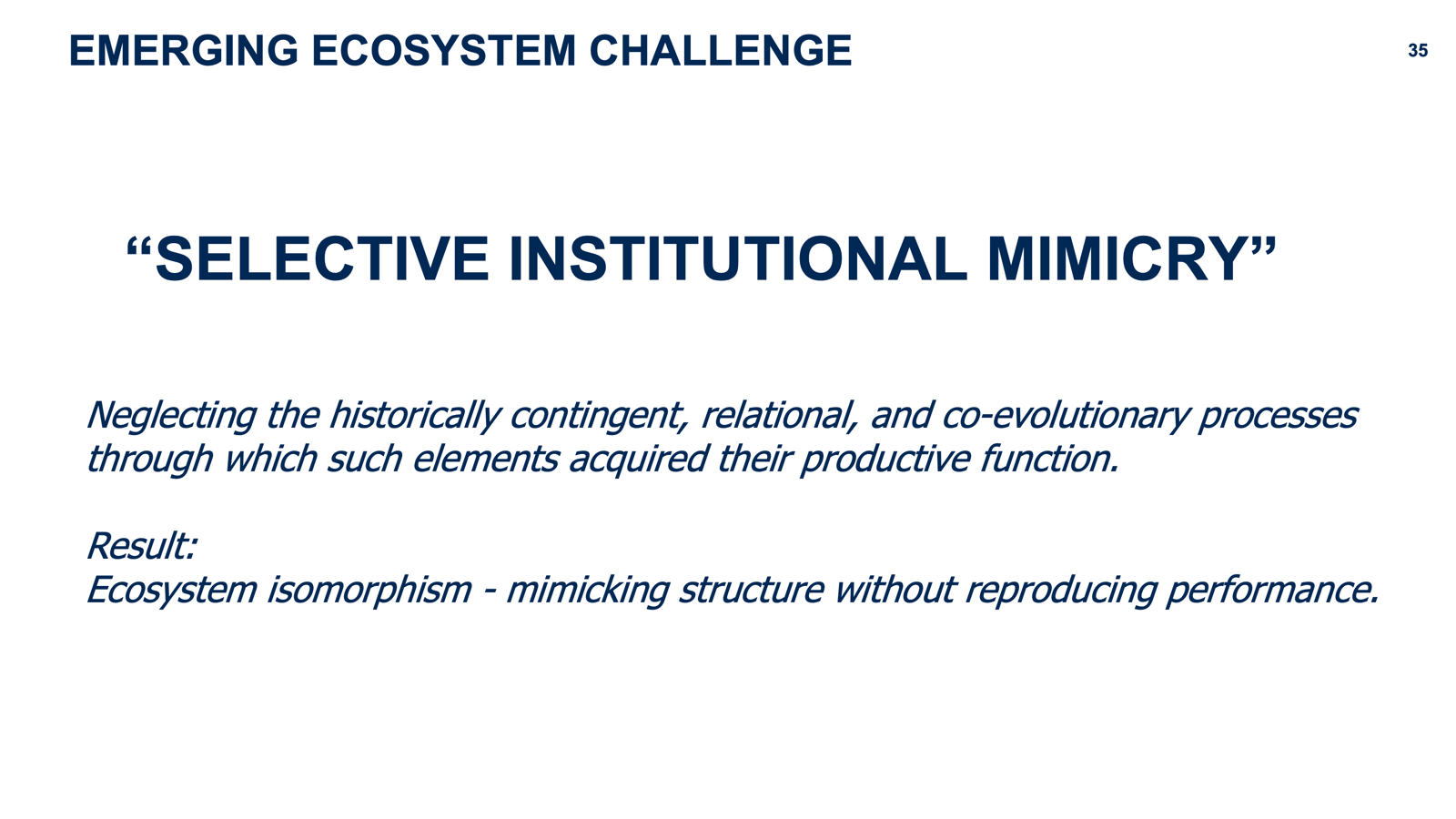
Selective institutional mimicry

Neglecting the historically contingent, relational, and co-evolutionary processes through which institutional elements acquired their productive function can lead to ecosystem isomorphism—mimicking structure without reproducing performance.

Selective institutional mimicry quote graphic
Conceptual summary of the emerging ecosystem challenge.
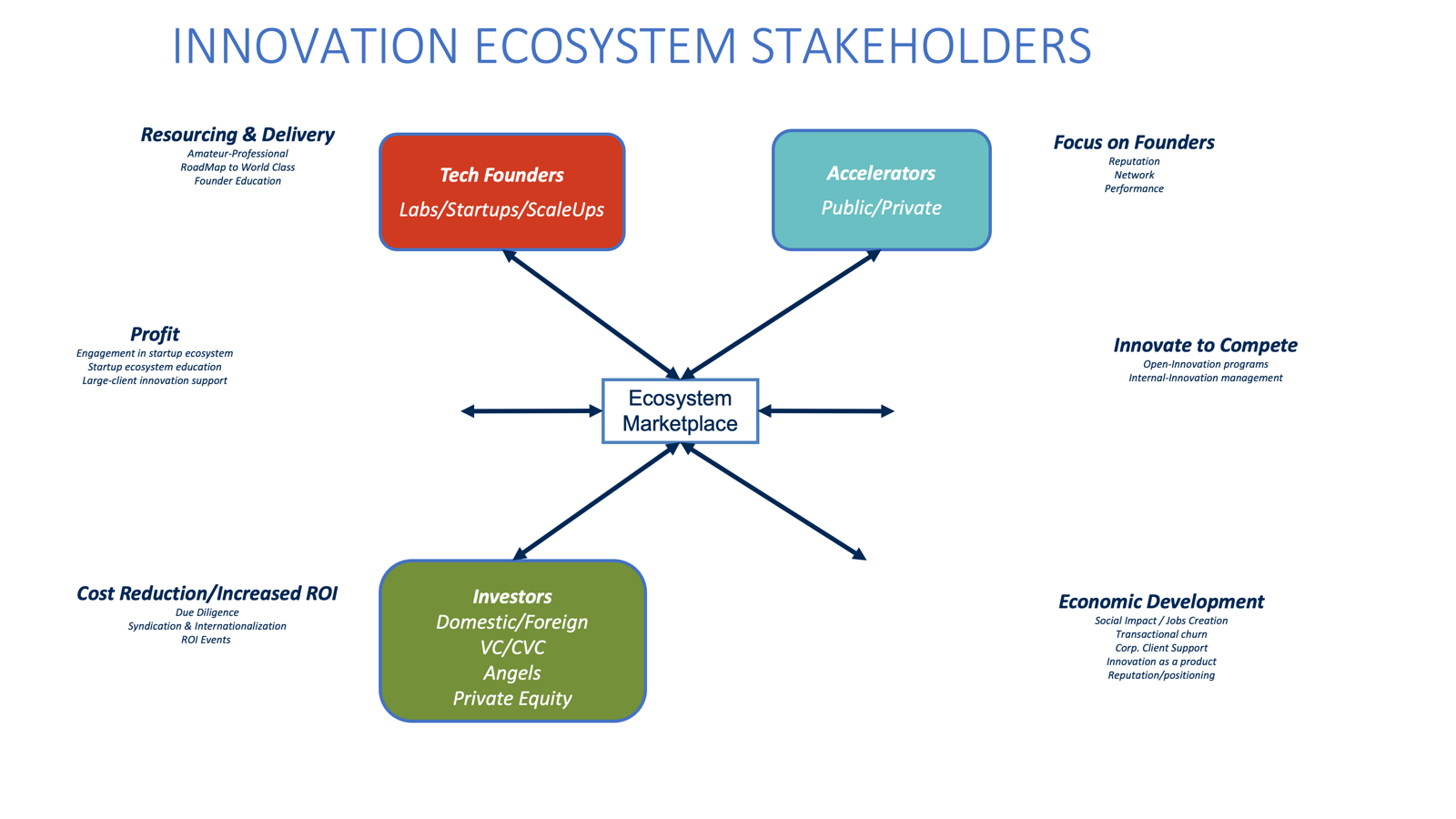
Diagram of an emerging innovation ecosystem with missing stakeholder groups
In this emerging ecosystem view, only a subset of roles receives sustained attention and support, leaving wide structural gaps in the innovation delivery system.
Research questions

Questions the ecosystem perspective helps answer.

Why aren't great science and good investors enough?

Because high-impact venture outcomes depend on more than the quality of an invention or the availability of capital. Emerging ecosystems can still lack startup-specific legal, commercial, technical, market, and institutional capabilities. When those complementary resources are weak or disconnected, promising ventures face friction even when science and investors are strong.

What makes an innovation ecosystem mature?

Maturity is reflected in the depth of specialized capabilities, repeated interaction among stakeholders, trusted information flows, and the ability to mobilize resources quickly. A mature ecosystem is therefore not simply a large collection of organizations; it is a co-evolved system in which complementary roles work together effectively.

What is selective institutional mimicry?

Selective institutional mimicry occurs when an emerging ecosystem copies the most visible structures of a mature ecosystem while neglecting the less visible relationships, capabilities, and historically developed practices that make those structures productive. The result can resemble maturity without reproducing mature-system performance.

Why does co-evolution matter?

Stakeholders improve partly through repeated interaction with one another. Founders, investors, service providers, accelerators, universities, corporations, government, and markets therefore develop in relation to the surrounding system. Co-evolution helps explain why capability gaps cannot always be solved by strengthening only one stakeholder group.

Research themes: Innovation ecosystem maturity · Venture capital ecosystem development · Co-evolution · Institutional capability · Investment decision speed · Startup-specific professional expertise · Resource mobilization · Competitive responsiveness
Implications

From analogy to action.

This comparison suggests that ecosystem development is not simply about copying visible institutions. It is about enabling co-evolution: building the capabilities, trust, repeated interactions, and supporting roles that allow an innovation system to become more balanced, more resilient, and more responsive over time.

For founders

Better ecosystems improve access to expertise, capital, and pathways for growth.

For institutions

Stronger intermediary and service capabilities reduce friction and improve system-wide performance.

For policy & practice

Ecosystem-building should strengthen missing relationships and underdeveloped roles—not just replicate visible structures.